Behind the Scenes: Building a Live TV News Set in 72 Hours
How our team designed, fabricated, and installed a full multi-position broadcast set on a three-day deadline — without cutting a single corner.

The call came in on a Monday morning. A regional broadcaster's flagship set had failed a fire inspection, and they needed a replacement — designed, built, painted, wired, and camera-ready — by Thursday's 6 p.m. broadcast.
Seventy-two hours. Multiple anchor positions. Full lighting integration. A budget already spent on the set they couldn't use.
We said yes. This is how.
Hour 0–8: Design lockdown
Our design team pulled the existing floor plan and the station's brand book while our shop foreman walked the studio to measure sight lines, camera distances, and the ceiling grid we'd hang lights from. Two hours in, we had a concept sketch. By hour six, we had CAD drawings, a materials list, and a cut schedule.
Nothing about that pace is possible without a shop this size. Ten thousand square feet means we don't wait for materials to arrive — the raw stock is already here.
Hour 8–40: Build
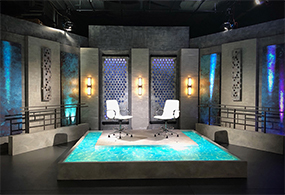
We ran two shifts in parallel. Welders and metal fabricators on the structural frame. Millwork on the anchor desk and the flanking columns. Painters standing by. A dedicated wiring bench pre-terminating every cable run before it ever left the shop.
Because we design and build under one roof, changes moved at conversation speed. When the lead designer wanted the anchor desk brought forward six inches for a better two-shot, it happened in the same afternoon.
Hour 40–68: Paint, assemble, load
Every panel got two coats of a custom-mixed low-gloss finish tuned for the studio's key lighting. Everything was pre-assembled on our floor first, photographed, disassembled, and loaded onto two trucks.
Hour 68–72: Install and light
The install crew rolled into the studio at 6 a.m. on Thursday. First panel up at 6:15. Full set standing by 11. Lighting director on site by 2 p.m. Camera checks at 5. Live broadcast at 6.
The anchors didn't miss a single beat. The audience didn't know anything had happened. Which is exactly how it should be.
Why this works
We don't outsource fabrication. We don't sub out finishing. We don't build off-site and hope the pieces fit when they arrive. Every discipline our clients need — design, weld, mill, paint, wire, install — lives in the same building, on the same team, working from the same drawings.
That's not a workflow. That's a set built to be built.